
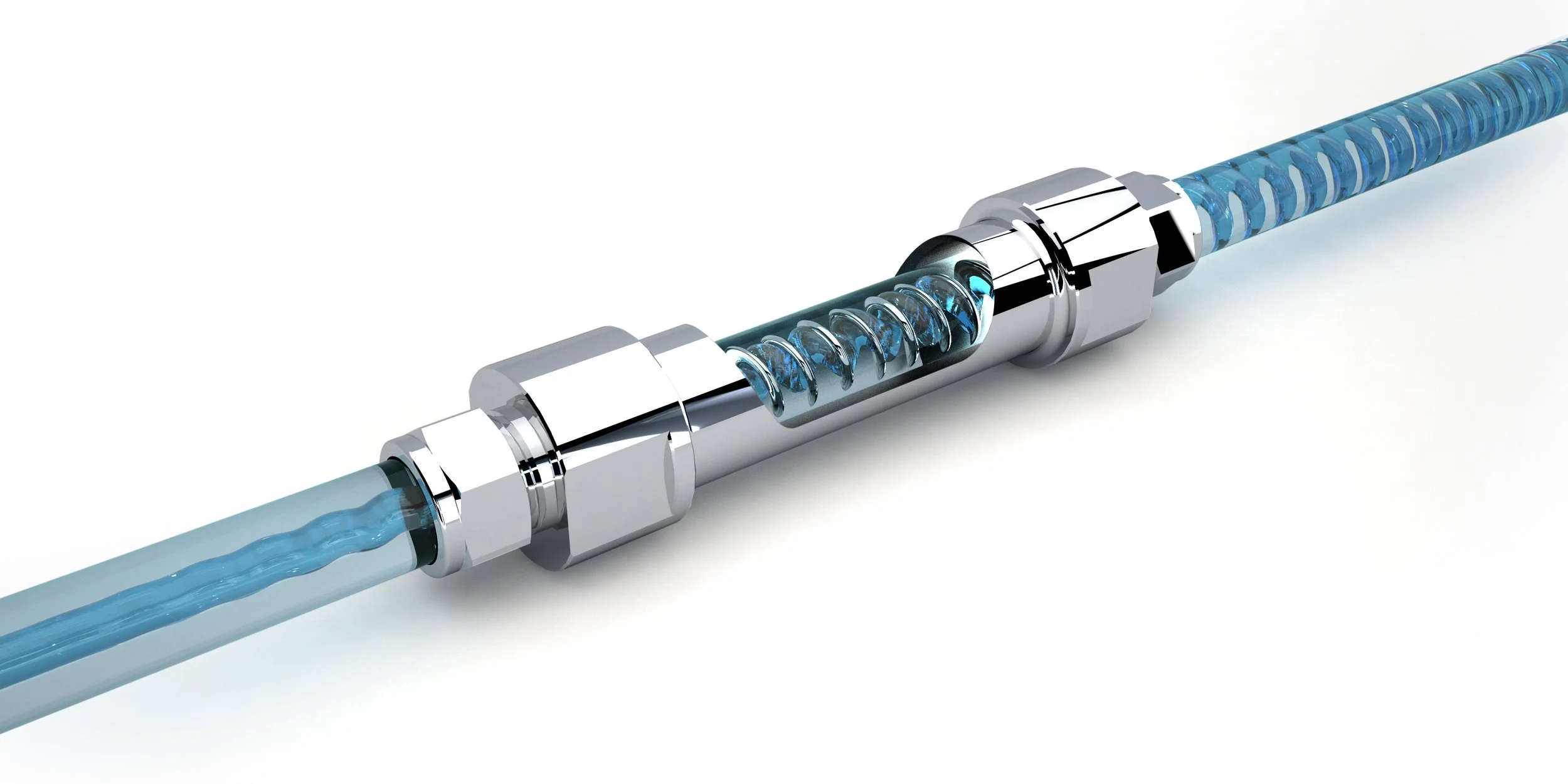
Inside an ActivFlo water conditioner, showing its patented alloy coil.
Stuart Gizzi, CEO of Intatec, explains what installers can look for on a routine call-out, how limescale forms and what to check before recommending a water conditioner.
‘Fancy a brew?’ Of course you do. Then you catch sight of the inside of the kettle and think, actually, I’ll stick with my flask in the van.
Limescale can be an issue for those living in a hard-water area, and if a customer is constantly descaling kettles and shower heads, it is worth further investigation.
If the customer says the shower keeps losing flow, have a look at the spray holes and ask whether descaling has helped before. Find out if they’ve noticed build-up elsewhere too. One fitting that’s due a clean is a different job from a house where several outlets and appliances are affected.
And, if you want to confirm how hard the supply is, start with the water company’s hardness data for the address. Take a look at the Drinking Water Inspectorate map for a more general guide to where hard water is found. Drinking Water Inspectorate map
Use the kettle to tell the story
The kettle is a handy way to explain what can happen out of sight. Hard water contains dissolved calcium and magnesium. When it’s heated, some of the dissolved calcium can come out of solution as solid calcium carbonate. That’s the crust you see in the kettle.
The same process can leave deposits on heating surfaces inside hot-water appliances. A layer of scale there can get in the way of heat transfer, reduce efficiency and shorten the life of a heating element. That’s worth explaining to someone who’s just paid for a new kitchen and wants to look after the appliances going into it. Drinking Water Inspectorate
Some science...
Calcium carbonate can form different types of crystal. Two you’ll hear about are calcite and aragonite. They’re made of the same stuff, but the crystals are arranged differently. Calcite tends to form dense deposits that grip surfaces, while aragonite can form deposits that are easier to dislodge. Research review on hard water treatment
What a catalytic conditioner is designed to do
In an alloy-core catalytic conditioner, water passes over a core designed to encourage aragonite to form (that’s the stuff that’s easier to clean off). The aim is to reduce the amount of hard scale that sticks to surfaces. The healthy minerals stay in the water. You might still see marks on the shower screen, but they’ll wipe away a lot more easily. Intatec’s guide to catalytic conditioning
If the customer is asking for softer water, that’s a different requirement. An ion-exchange softener reduces hardness by exchanging calcium and magnesium ions for sodium ions. Drinking Water Inspectorate
Considerations
A salt-based softener needs regular salt top-ups. If the customer’s main concern is scale build-up, a passive inline conditioner can go straight into the pipework and run without a power supply or added salt.
Check the flow before you pick the fitting
Say you’re looking at treating the whole house and the incoming pipework is 22 mm. You know what connection you’re dealing with. A reducing set can give you the option of fitting the same unit to 15mm pipework, where the manufacturer allows for it.
Either way, check how much water will pass through the conditioner in everyday use, including when more than one outlet is running. Compare that with the manufacturer’s published range. The fitting might go straight on, but the flow rate tells you whether it’s the right unit for the job. If the customer’s only dealing with scale at one appliance, check the flow there. Treating just that appliance might be all they need.
Intatec manufactures the ActivFlo range of water conditioners. You can reach its technical team on 01889 272199 or at technical@intatec.co.uk.
Related video
See what the installation looks like on a real job. Watch Chirag fit an ActivFlo on site for PHPI.
PR for the plumbing and heating industry by Reeves in Birmingham and Newcastle upon Tyne.